What are the six safe sleep recommendations?
Red Nose recommends six key steps to reduce the risk of sudden infant death, for all babies from birth to 1 year. Our safe sleep recommendations are based on research and are shown to reduce the risk to your baby whilst they are sleeping. Following them for every sleep will help keep your baby safe.
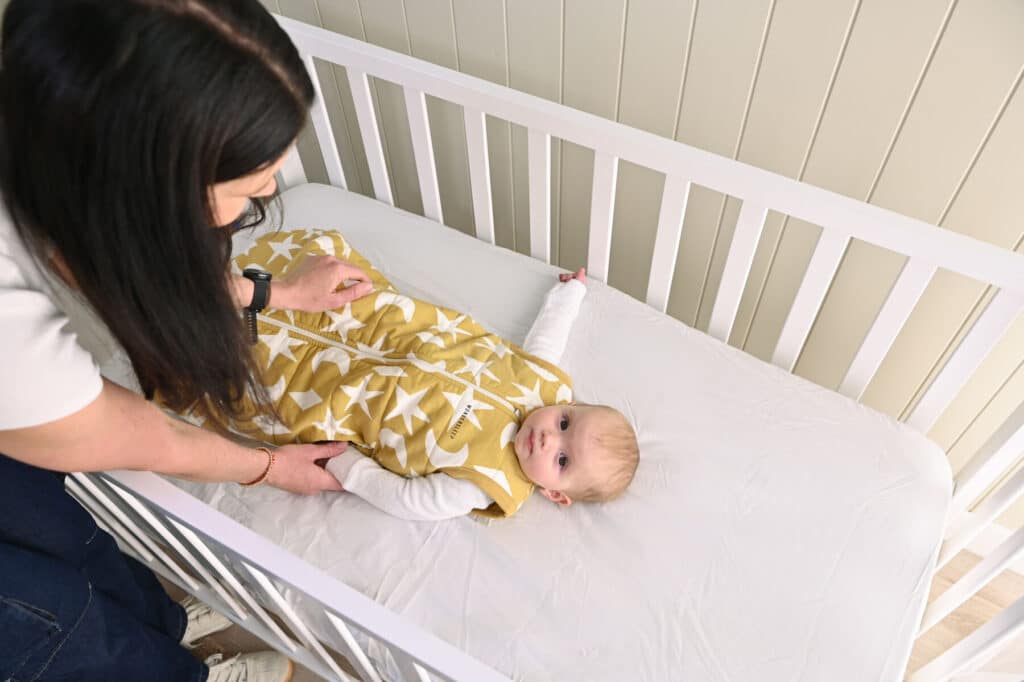
Always place baby on their back to sleep.
Placing baby on their back to sleep helps keep their airway clear and ensures their protective reflexes work. Back sleeping reduces the risk of suffocation, overheating, and choking.
Keep baby’s head and face uncovered.
Babies control their temperature through their face and head, so keeping baby’s face and head uncovered during sleep helps reduce the risk of overheating. It also helps keep their airways clear, which reduces the risk of suffocation.
Keep baby smoke-free, before and after birth.
Smoking during pregnancy and around baby once they are born increases the risk of sudden infant death – this includes second-hand smoke. If you or your partner smoke, don’t smoke around baby and never smoke where baby sleeps. For free help to quit smoking, call Quitline on 13 78 48.
Provide a safe sleeping environment, night and day.
The safest place for baby to sleep is in their own safe space, with a safe mattress and safe bedding. Baby should always be placed on their back to sleep, with their feet at the bottom of the bassinet or cot.
- Choose a safe cot, which meets mandatory Australian Standards. For more information, visit the Australian Government’s Product Safety website regarding mandatory standards for infant sleep products.
- Choose a safe mattress, which is firm, flat, the right size for your safe cot, and meets voluntary Australian Standards.
- Choose safe bedding, which is lightweight, firmly tucked in and only pulled up to the chest.
- If using one, choose a safe sleeping bag, which is well fitted across the neck and chest, with baby’s arms out, and no hood.
- No soft surfaces or bulky items. Don’t use any soft items in the cot. Soft items in the sleep space are dangerous and increase the risk of suffocation and overheating. This includes things like doonas or loose blankets, pillows, cot bumpers, lambswool, and soft toys like a teddy or comforter.
Sleep baby in their own safe sleep space, in the same room as their parent or adult caregiver, for at least the first 6 months.
The safest place for baby to sleep is in their own safe space, in the same room as their parent or adult caregiver, for at least the first 6 months.
Breastfeed baby, if possible.
Breastfeeding has been shown to reduce the risk of sudden infant death.

Check out our handy Safe Sleeping Guide for how to safely sleep your baby
If you’re looking for information on bassinet use, find out more now.
If you’d like some advice on how to safely sleep your little one, please call the Red Nose Safe Sleep Advice Line on 1300 998 698 or email us today.We’re here to answer your questions between 9am and 5pm Monday to Friday (AEST).

Red Nose does not recommend co-sleeping as there is evidence that co-sleeping may lead to unsafe sleeping practices. However, some families choose to or find this happens accidentally. Find out how to co-sleep in a way to best reduce risk or view the co-sleeping guide.
Safe sleep recommendations: frequently asked questions
Do the safe sleep recommendations apply to day sleeps too?
Yes. Follow our safe sleep recommendations for every sleep, night and day, for all babies from birth to 1 year. A safe sleeping environment is just as important for daytime naps as it is overnight.
Why are the safe sleep recommendations so important?
It is currently believed that sudden infant death occurs when several things happen at the same time. The Triple Risk Model describes three factors: a vulnerable baby, the baby’s age (the risk is greatest in the first year of life, particularly the first six months), and the sleep environment. We can’t change a baby’s age or an underlying vulnerability, but taking care of the environment around the baby helps to decrease the risk. Why are safe sleeping recommendations so important?
Why should I sleep my baby on their back?
When a baby is on their back, the tube that carries air to the lungs sits above the tube that carries food to the stomach. Regurgitated milk pools at the back of the throat and can be easily swallowed, so the risk of choking is reduced. It is a misconception that a baby can choke on vomit while sleeping on their back. Why should you sleep your baby on their back?
Can my baby sleep on their side?
No, only if a doctor or medical professional has told you to do so. Side sleeping is not a safe alternative to back sleeping. The side position is unstable, and baby is more likely to roll onto their front. Can baby be slept on their side?
What should I do when my baby starts rolling over?
Stop wrapping and, if you use a bassinet, move baby into a safe cot as soon as they show signs of rolling. Keep placing baby on their back to sleep. If baby can only roll one way, gently roll them onto their back. Once baby can roll confidently in both directions, let them find their own natural sleeping position. Baby rolling over: what to do next
How long should my baby sleep in the same room as me?
For at least the first 6 months, sleep your baby in their own safe sleep space in the same room as their parent or adult caregiver. Room sharing reduces the risk of sudden infant death and sleeping accidents during daytime and nighttime sleeps. Room sharing
What if I can’t breastfeed my baby?
We understand that not all parents can breastfeed, and some choose not to. If breastfeeding is not possible, you can still significantly reduce your baby’s risk by following the other five safe sleep recommendations. Does breastfeeding reduce the risk?
Does Red Nose recommend co-sleeping?
No. There is evidence that co-sleeping may lead to unsafe sleeping practices. However, some families choose to co-sleep or find it happens accidentally. Find out how to co-sleep in a way to best reduce risk.
Who can I talk to about safe sleep?
Call our Safe Sleep Advice Line on 1300 998 698 or email us. We’re here to answer your questions between 9am and 5pm, Monday to Friday (AEST).

Is English not your first language?
Find Safe Sleep & Safer Pregnancy advice in your language now

We’re here to help.
Call our Safe Sleep Advice Line on 1300 998 698 for free, expert support and evidence-based guidance. Whether you’re a parent, grandparent or carer, our Safe Sleep Educators can help you feel confident about your baby’s sleep safety.
Available during business hours.
Call 1300 998 698 Explore our Safe Sleep and Safer Pregnancy hubDid you find this helpful?
Good job! Please give your positive feedback
How could we improve this post? Please Help us.